California voters approved the project in 2008 with a $33-billion price tag. The cost has nearly quadrupled, the completion date has slipped to 2033, and the funding gap is roughly $90 billion. Carney's Liberals have already committed $4.3 billion to a near-identical project in Canada — and not a single track has been laid here either.
In 2008, California voters approved a $33-billion high-speed rail project to connect Los Angeles and San Francisco. Anthony Williams, a board member of the California High Speed Rail Authority, told CBS’s 60 Minutes on Sunday that the current cost estimate is approximately $126 billion. That figure is nearly four times what voters were told it would cost. “Today, we estimate with the right optimization just over $125 billion,” Williams said. “I think $126 billion is the current estimate for that.”1
It is now 2026. Eighteen years after voters approved the project, no high-speed rail track has been laid. The US Department of Transportation confirmed the point in a statement to Newsweek: “After 16 years and roughly $15 billion spent, not one high-speed track has been laid by the California High-Speed Rail Authority.” The earliest projected opening date has slipped from 2028 to 2033. The funding gap between what the state has and what it needs is approximately $90 billion. The project has had 597 change orders costing more than $2.3 billion — equivalent to roughly 7% of the original $33-billion budget, and that figure represents only the cost of the changes, not the project itself.2
❝ After 16 years and roughly $15 billion spent, not one high-speed track has been laid by the California High-Speed Rail Authority.
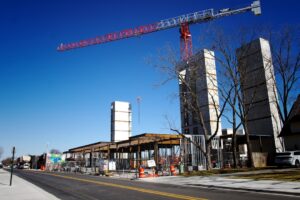
— US Department of Transportation statement to Newsweek, January 2026What has been built, after 18 years, is civil construction. Approximately 80 miles of guideway — the concrete viaducts, bridges, and road structures that future high-speed rail track will eventually sit on — have been completed across the Central Valley. 58 structures are finished, with another 29 under construction. A 150-acre Southern Railhead staging facility was completed in Kern County in early 2026 to receive and stage materials for eventual track installation. Temporary freight tracks have been installed at the railhead to deliver materials. None of this is high-speed rail track. Track installation contracts are not scheduled to be awarded until Q2 2026, with actual track-laying planned to begin “before the end of 2026.” That timeline slips every year.3
The only visible high-speed rail construction is on a single segment between Bakersfield and Merced in the Central Valley — a stretch connecting two mid-sized cities in a corridor that was chosen specifically because of low land-acquisition costs, not because the cities it connects have significant intercity travel demand. The San Francisco Bay Area and the Los Angeles Basin, where the actual travel demand exists, are still years or decades away from any construction. The segments that would justify the project on its own terms are the segments that have not been built.
Republican Representative Vince Fong of California has been one of the project’s most vocal critics. “We’re now in 2026: There are no trains; there’s no track laid; it was a complete bait and switch,” Fong told 60 Minutes. He has described the project as “the quintessential example of government waste and mismanagement” and has called for it to be cancelled before more money is spent. “Hardworking California taxpayers cannot afford to let this continue,” Fong wrote in a statement in February 2026. “This project should be cancelled before even more money and time are wasted.”4
State officials have begun to acknowledge the criticism. California Transportation Secretary Toks Omishakin admitted to CBS that “there were mistakes made” and that some of the criticism of the project “was very fair.” “I don’t think the voters fully understood, and neither did we, what it was going to take to actually get this project delivered,” Omishakin said. The acknowledgement is striking because it comes from the state cabinet officer responsible for transportation policy.5
The Trump administration cut $4 billion in federal funding for the project last year, citing nine compliance failures including a $7-billion funding shortfall. President Trump called it “the worst cost overrun” he had “ever seen.” Earlier this year, Congress cut another $929 million. Transportation Secretary Sean Duffy referred to the project as “Newsom’s Disaster” in a statement to CBS News and said the administration would not stand for “boondoggle projects like Newsom’s Train to Nowhere that wasted billions in taxpayer dollars yet delivered nothing to the American people.”6
Even Newsom himself cast doubt on the full San Francisco-to-Los Angeles vision back in 2019, when he scaled back the original plan and acknowledged that “there simply isn’t a path” to the original timeline. The project nonetheless continued. The 2019 retrenchment reduced the scope without reducing the cost trajectory. Seven years later, the cost estimate has grown by tens of billions and the only visible progress remains the single Central Valley segment.7
❝ For $10 billion, Elon Musk put 300 rockets in orbit. For $11 billion, the state of California has built 1,600 feet of elevated rail with no rail.
— Shyam Sankar, Chief Technology Officer, Palantir Technologies, 2024The most damning comparison comes from Palantir CTO Shyam Sankar, who put the spending in 2024 against a private-sector benchmark. “For $10 billion, Elon Musk put 300 rockets in orbit,” Sankar said. “For $11 billion, the state of California has built 1,600 feet of elevated rail with no rail.” The arithmetic is the kind that politicians prefer not to address. SpaceX achieved orbital reusability for less than the cost of a few hundred metres of empty viaduct in California’s Central Valley.8
California: 18 years, $126B, zero high-speed track. Canada: $4.3B spent, construction in 2029, zero track.
State officials say they remain confident more money can be found to keep the project moving. The funding gap of $90 billion would have to come from federal sources, state sources, or private investors. The Trump administration has already cut its contribution. The state legislature is constrained by California’s own budget pressures. Private investors have shown little appetite for an infrastructure project that has already missed every deadline and quadrupled its cost. The project continues anyway, sustained by sunk-cost momentum and political reluctance to take the loss.
Eighteen years and $126 billion is the cautionary tale. It is also the project Canada is now starting. On February 19, 2025, the Trudeau Liberal government announced a six-year, $3.9-billion design and development plan for a high-speed rail line linking Toronto and Quebec City — a 1,000-kilometre corridor named Alto. An additional $371.8 million had been previously committed in the budget. Total Canadian commitment to the project, in the design phase alone: roughly $4.3 billion. Construction of the first phase, between Montreal and Ottawa, is not scheduled to begin until 2029 or 2030. The full project is estimated to cost between $60 billion and $90 billion. Bloomberg has reported the C$90-billion figure as the most likely estimate.9
That is roughly the same per-kilometre cost trajectory California started with — and California’s project is now four times its original estimate, 18 years overdue, and still without a single laid high-speed rail track. Canada has not laid a track either, and will not for at least three more years even if the current schedule holds. The $4.3 billion already committed has gone entirely into design, planning, consultations, and the establishment of Alto as a Crown corporation. The Carney government’s Major Projects Office recognized Alto as a “transformative strategy” earlier this year. Transport Canada said in December that consultations on the high-speed rail line would begin in 2026, with construction of the first Ottawa-Montreal segment in 2029.10
On April 7, 2026, Prime Minister Mark Carney defended the project at a news conference in Brampton, Ontario. He said the project would create more than 50,000 jobs and contribute more than $35 billion to the economy. “When you look at the overall picture, what the high-speed rail does, is it’s more cost-effective, it’s more sustainable, it’s connecting our communities, it’s going to be faster,” Carney said. He addressed growing opposition from rural communities along the proposed route by noting that the project would require only about 10 metres of land for the rail corridor and that landowners would be compensated.11
The opposition is real. The Ontario Federation of Agriculture and Quebec’s Union des producteurs agricoles have called for the project to be suspended. At least five eastern Ontario townships have passed resolutions opposing the proposed southern route. More than 14,000 people have joined Facebook groups opposed to the project. A McGill University report found that Alto would not become self-sustaining until Year 48 of operation. Matti Siemiatycki, director of the University of Toronto’s Infrastructure Institute, told Canadian Affairs: “This project feels like a nice to have, not a need to have.”12
There is also an ethics issue. Finance Minister François-Philippe Champagne has recused himself from all decisions related to Alto because his partner, Anne-Marie Gaudet, took the position of vice-president of environment at Alto in August 2025. Conservative MP Michael Barrett, the party’s ethics critic, has asked the federal ethics commissioner to investigate whether Champagne breached the Conflict of Interest Act in relation to Alto. Carney told reporters on April 7 that Champagne is following government ethics rules and called the recusal arrangement “a good situation.”13
Conservative Leader Pierre Poilievre called for the project to be cancelled on March 31, calling it a “boondoggle” that would “confiscate farmland and private property, disrupting communities and harming the quality of life of local residents who will not even get to use the train because it won’t have any stops near their homes.” Transport Minister Steven MacKinnon responded that Poilievre was “turning his back on Canadians from Quebec City to Toronto and the communities in between.”
The pattern is identical. Voters approve a project on a stated cost. The cost grows. The timeline slips. The funding gap widens. Construction does not begin on the original schedule. Each delay produces a new cost estimate, which produces a new funding ask, which produces a new timeline, which produces a new delay. Eighteen years on, California has spent more than $15 billion, has 80 miles of empty concrete guideway, has no laid high-speed rail track, and is now estimating $126 billion to finish what it told voters in 2008 would cost $33 billion.
Canada is at year one. The federal government has already committed $4.3 billion to design and development. Construction is not scheduled until 2029. The full cost estimate is already $60 to $90 billion before the first shovel hits the ground. Canada is the only G7 country without high-speed rail. Twenty-eight studies have been completed on the Quebec City–Windsor corridor since 1992. The political appetite has come and gone repeatedly across multiple governments. The Carney government has now made it a flagship project — the same kind of nation-building announcement that California made in 2008.
California voters approved a $33-billion high-speed rail project in 2008. Eighteen years later, the cost estimate is $126 billion, the completion date has slipped to 2033, the funding gap is roughly $90 billion, and not a single mile of high-speed rail track has been laid. The US Department of Transportation confirmed the point: after 16 years and $15 billion spent, not one high-speed track exists. California has 80 miles of empty concrete guideway, a 150-acre material staging yard, and 58 finished road structures — but no rail to run a train on. Even California’s own transportation secretary admits “mistakes were made.” The Trump administration has cut $4.9 billion in combined funding. The Palantir comparison stands: $11 billion for 1,600 feet of viaduct with no rail, while $10 billion put 300 SpaceX rockets in orbit. That is the project Canada is now copying. The Liberal government has committed $4.3 billion to the design and development phase of Alto, the Toronto-to-Quebec-City line. Construction is not scheduled to begin until 2029 or 2030. The full cost estimate is already $60 to $90 billion. The finance minister has recused himself due to a personal connection to an Alto executive. Rural communities are opposed. The Ontario Federation of Agriculture has called for the project to be suspended. A McGill report says it will not break even for 48 years. And not a single track has been laid in Canada either. California’s $126-billion cautionary tale is on television tonight. Carney’s government is watching it on a different channel.
Every source. Every contradiction. Yours to share.